Dangerous Goods
by Ferry
Make sure your load meets code requirements before it reaches the terminal. What you need to know in advance.
Codes & Requirements
| Maritime New Zealand set rules for how dangerous goods can be transported at sea. The requirements are in place to protect the lives of seafarers and passengers, the safety of vessels and the marine environment. |
KiwiRail and Interislander are committed to the safety and wellbeing of all people involved in our operations – including employees, contractors, clients, partners and passengers. This also extends to the environment we interact with as part of our business.
Transporting dangerous goods across the Cook Strait is subject to the regulations of Maritime New Zealand.
You are required to ensure your goods comply with the following regulations:
- IMDG Codeopen_in_new
- Maritime Rule Part 24Aopen_in_new , 24Bopen_in_new, 24Copen_in_new , 24Dopen_in_new and 150open_in_new
- SOLAS Chapter VII Carriage of Dangerous Cargoopen_in_new
- General Harbour Regulations 1968open_in_new
- Maritime Transport Act 1994 Amendmentsopen_in_new (previously part 12)
- Maritime Transport Act 1994 Part 19open_in_new
- Hazardous Substances and New Organisms Act 1996open_in_new
Before accepting any cargo on board the vessel, our Masters and Officers who manage the cargo decks check that all cargo has the relevant certification and placarding to ensure it meets the IMDGopen_in_new code as required by Maritime New Zealand.
Health and safety is our priority and Interislander’s PCBU officers carry out their duties to ensure they have eliminated as many risks as far as is reasonably practicable as per the NZopen_in_new HSE open_in_newAct 2015open_in_new.
Where it’s not reasonably practicable to eliminate health and safety risks, our officers will look to minimise the risks. Interislander requires all commercial vehicle customers to ensure 100% compliance to the regulations stated above before arriving at our terminals.
Training is mandatory for all those involved in the transport chain of dangerous goods by sea. This applies to consignors, shippers and forwarders, container packers and consolidators, shipping line operations and booking staff, stevedores and port staff. Details and guidance on the requirements are in the IMDG chapter 1.3.
We operate machinery and plant at our terminals and onboard our ferries that has the potential to cause notifiable injuries and illnesses.
To help you stay safe, please read the Interislander CV Safety Briefingopen_in_new (248 KB, Pdf) and familiarise yourself with the hazards and the appropriate controls at our terminals and on board the ferries.
Please be on the lookout for the Personal Protective Equipment Zones in the commercial vehicles area of the Picton and Wellington terminalsopen_in_newopen_in_new. Hi Vis clothing to AS/NZS4602open_in_new standards and safety footwear is mandatory in these zones.
Declaration Requirements
You can complete your Dangerous Goods Declaration using Passport - our preferred declaration method. Alternatively, you may complete a Declaration Manifest and submit via email at least 4 hours before departure.
-
Passport (Preferred)
This portal is the preferred declaration method for dangerous goods on the Interislander.
Stowage Categories
Category A dangerous goods are permitted to be carried on passenger sailings, with the exclusion of radioactive material which is limited to Aratere sailings only.
^^Aratere is no longer in service - what is the updated information?
Category D & E dangerous goods are limited to our freight only sailings. For any enquiries, please call 0800 660 670.
^^Should we include links to the Stowage Classes and Dangerous Goods categories? They are referenced on this page, but are not easily found in the lengthy code and legislation documents referred to.
Dangerous Goods Inspections
All Commercial Vehicles carrying dangerous goods will be inspected at the terminal prior to being allocated a place on board, and once on board, a secondary check will be carried out by the loading deck mate. The checks will ensure:
- The vehicle has the correct paperwork and DG placards as per the IMDG Code; and
- The vehicle complies with the requirement of the New Zealand Transport Act 1994; and,
- No leaks are sighted or unusual smells emanating from the container/vehicle; and,
- Old DG placards are removed if these aren’t applicable to the freight being transported.
If a vehicle does not meet the requirements stated above, Interislander will refuse passage.
|
Please note: Interislander no longer stock placards on site at our terminals. Vehicles not displaying the correct placards will not sail until suitable placarding is obtained for travel. |
Electric Vehicles on Car Carriers
If you are booking a car carrier unit that will be carrying any electric or alternative fueled vehicle, including hybrids, please be aware that:
- You need to book either Kaitaki or Kaiarahi
- We cannot accept electric vehicles or alternative fueled vehicles if they have been damaged or modified.
- Any electric vehicles should not have been fully charged within 12 hours of being loaded onto transporter.
- Battery charge level should be less than 30% once loaded on car transporter – charge level ideally to be written on window.
- You will need to submit a dangerous goods declaration for any electric cars onboard.
- Hydrogen powered vehicles are restricted to uncovered areas of weather decks of vessels – When making a booking please request as a ‘’TOP DECK’’ stowage.
Information for Electric Vehicles
This is for vehicles on a car carrier truck only and not personal vehicle driven on.
Electric vehicle on truck will be treated as dangerous goods class 9 Miscellaneous Goods. Complete the declaration manifest as stated below:
| Required Field(s) | Instructions |
| Un Number | UN3171 – Battery powered vehicle. |
| Unit of volume | Is not needed - Enter as 001. |
| KG | 1200kg roughly per vehicle |
| Additional Information | Enter battery level of vehicle, confirm it is less than 30% |
| Truck Layout |
Electric vehicles on truck to be shown on diagram, with the tops half being top ramp and bottom half lower ramp. If you have a flat deck truck, please use the single unit document on our dangerous goods informationopen_in_new. |
| Placards on Truck | We will require class 9 placards be displayed on the front and rear of the truck while travelling with Interislander. |
|
Please note: Interislander no longer stock placards on site at our terminals. Vehicles not displaying the correct placards will not sail until suitable placarding is obtained for travel. |
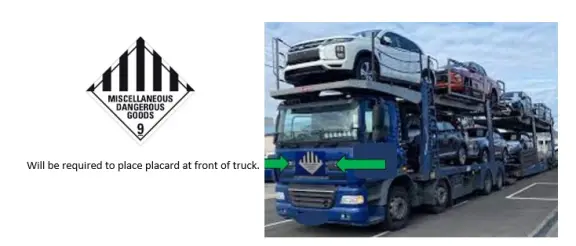
Example of placard placement
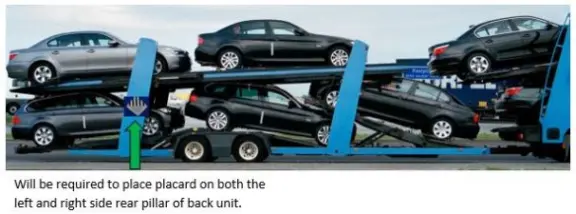
Trucks that do not have a solid rear surface require placards on both the left and right side of unit.